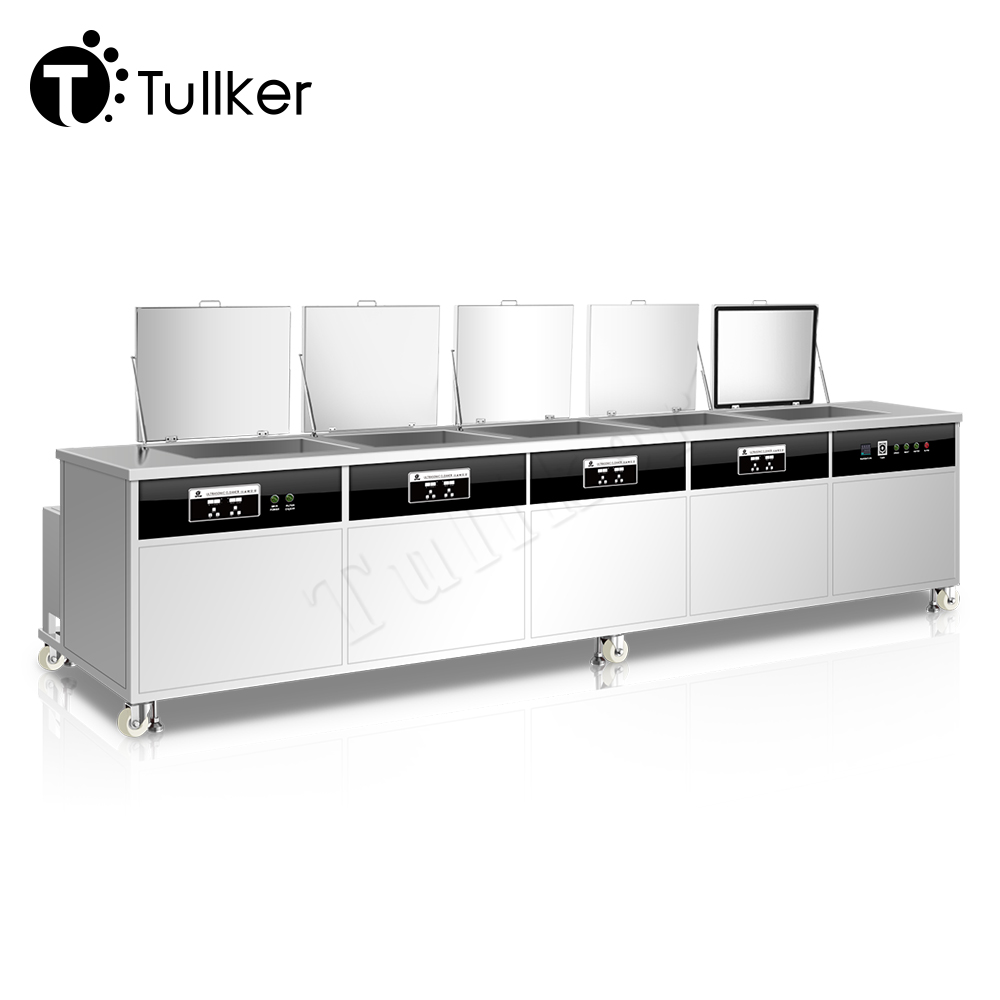



An ultrasonic cleaning machine is a device that uses ultrasonic energy to clean objects. It features high efficiency, safety, and ease of operation, and is widely used in various industries. For ceramic products, cleaning is often difficult due to the presence of adhering substances such as dust, oil stains, and rust. The emergence of ultrasonic cleaning machines provides strong technical support for solving the problem of cleaning these adhering substances from ceramic products.
I. Working Principle of Ultrasonic Cleaning Machines
Ultrasonic cleaning machines primarily utilize the cavitation effect of ultrasound in liquids. When ultrasound propagates in a liquid, it generates alternating positive and negative sound pressure. This sound pressure creates tiny bubbles in the liquid. As the ultrasound vibrates, the volume of these bubbles constantly changes. When subjected to negative pressure, the bubbles rapidly shrink; when subjected to positive pressure, they rapidly expand. This formation and collapse of bubbles is the cavitation effect of ultrasound. In an ultrasonic cleaning machine, the cleaning liquid is placed in a cleaning tank, which is then excited by a high-frequency electrical signal from an ultrasonic generator to produce ultrasound. As the ultrasound propagates in the cleaning liquid, it generates tiny bubbles through cavitation. These bubbles vibrate and collapse under the action of sound pressure, generating powerful impact forces. This impact force can break down the adhering substances on the surface of the ceramic product, thus achieving the purpose of cleaning.
II. Application of Ultrasonic Cleaning Machines in Ceramic Product Cleaning
1. Preparation before cleaning: Before using an ultrasonic cleaning machine to clean ceramic products, the ceramic products need to be classified, and appropriate cleaning agents and cleaning liquids should be selected according to different cleaning requirements. At the same time, the ultrasonic cleaning machine needs to be inspected to ensure that it can operate normally.
2. Cleaning steps: Mix the selected cleaning agent and cleaning liquid in a certain proportion and pour them into the cleaning tank. Then, place the ceramic products into the cleaning tank, close the lid, and turn on the ultrasonic generator. Under the action of ultrasound, the tiny bubbles in the cleaning liquid will rapidly vibrate and collapse, generating powerful impact forces to break down and clean the adhering substances on the surface of the ceramic products.
3. Cleaning effect: After cleaning is complete, the cleaning effect of the ceramic products needs to be evaluated. The cleaning effect of the ultrasonic cleaning machine can be evaluated by visually observing the cleanliness of the ceramic product surface and by measuring the dimensions of the ceramic product using measuring tools. If the cleaning effect is unsatisfactory, the parameters of the ultrasonic cleaning machine can be adjusted, or a more suitable cleaning agent and cleaning solution can be used.
III. Advantages of Ultrasonic Cleaning Machines
1. High efficiency: Ultrasonic cleaning machines can quickly remove contaminants from the surface of ceramic products in a short time, resulting in high cleaning efficiency.
2. Safety: Ultrasonic cleaning machines use a liquid medium for cleaning, avoiding damage to the surface of ceramic products caused by mechanical force, making them safe and reliable.
3. Easy operation: Ultrasonic cleaning machines are easy to operate; the cleaning process is automatically completed by simply pressing a switch.
4. Environmentally friendly: Ultrasonic cleaning machines use environmentally friendly cleaning agents and solutions, resulting in minimal environmental pollution.
IV. Conclusion
Ultrasonic cleaning machines provide a technological solution to the problem of cleaning contaminants from ceramic products. They offer advantages such as high efficiency, safety, and ease of operation, enabling the rapid removal of contaminants from the surface of ceramic products and improving their cleanliness and dimensional accuracy. In the future, with continuous technological advancements and the expansion of application fields, ultrasonic cleaning machines will play an increasingly important role in more areas.